Kaza will not be the highlight of your Spiti trip, and it isn't trying to be. It is the valley's engine room: the subdivisional headquarters, the one fuel pump, the taxi stand, the market where villages restock, and the place where every traveller — biker, backpacker, family in an SUV — pauses to acclimatise and organise. Use it well and the rest of Spiti opens up smoothly. Skip its lessons (mainly: slow down, stock up) and the valley will teach them harder later.
Orientation: old town, new town, river
Kaza sits on the north bank of the Spiti river at roughly 3,650–3,800 m, split loosely into an old quarter of traditional whitewashed houses and a newer market area of hotels, cafés, and shops. Above town rises the modern Sakya monastery (Kaza gompa), worth an hour for its prayer hall and the view over the rooftops to the river. The whole town is walkable in an afternoon — which is exactly the kind of gentle activity your first day at altitude should consist of.
Job one: acclimatise
Whatever your itinerary says, Kaza's first function is physiological. At nearly 3,800 m, it is high enough to start acclimatisation but low enough to be forgiving — the ideal staging post before the 4,400 m villages. Spend at least one night here before sleeping higher (Langza, Komic, Kibber), especially if you arrived via the fast Manali road. Walk slowly, drink constantly, eat light, skip alcohol, and treat a mild headache as a signal to rest, not push. Our camping in Langza guide covers altitude in more detail.
The practical checklist
Kaza is the last full-service stop in the valley. Before heading to the villages, run this list:
- Cash. Kaza has bank branches and ATMs, but they are unreliable — machines run dry and links drop. Arrive with enough cash for your whole trip; use Kaza's ATMs only as a backup. There is nothing above Kaza.
- Fuel. The town's fuel station — celebrated as one of the world's highest retail outlets — is the valley's only pump. Fill up every time you pass, whichever direction you're headed.
- Network. BSNL and Jio are your best bets in town; expect little or nothing in most villages. Download offline maps and any entertainment now.
- Supplies. The market covers essentials — snacks, water, batteries, basic medicines, warm layers if you underpacked, and a pharmacy. Stock for village stays here.
- Transport. The taxi stand runs fixed-rate trips to every corner of the valley, including the Langza–Hikkim–Komic circuit. HRTC buses connect Kaza down-valley toward Reckong Peo year-round and toward Manali in season — details in how to reach Langza.
A good acclimatisation day in Kaza
Morning: slow breakfast, then the Sakya monastery and a wander through the old town's lanes. Afternoon: the café scene — Kaza has developed a genuinely pleasant run of traveller cafés serving everything from thukpa to espresso; an unhurried lunch is practically medicinal at altitude. Evening: the market for supplies, an early dinner, and a first taste of the night sky from the riverside — a preview of what the Bortle 1 villages above will show you properly.
Day trips: what Kaza launches
- Key Monastery (~14 km): Spiti's iconic thousand-year-old monastery, stacked like a sandcastle on its hill. Combine with Kibber and Chicham.
- Kibber & Chicham Bridge (~20 km): a high wildlife-rich village and the spectacular suspension bridge over the Samba gorge — celebrated among Asia's highest.
- Langza–Hikkim–Komic circuit (~45 km loop): the Buddha, the world's highest post office and a clifftop monastery in one half-day loop.
- Tabo (~47 km): the valley's oldest monastery — over a thousand years of murals — down the Shimla road.
- Pin Valley (~30+ km): a wilder side valley of green oases and ibex country.
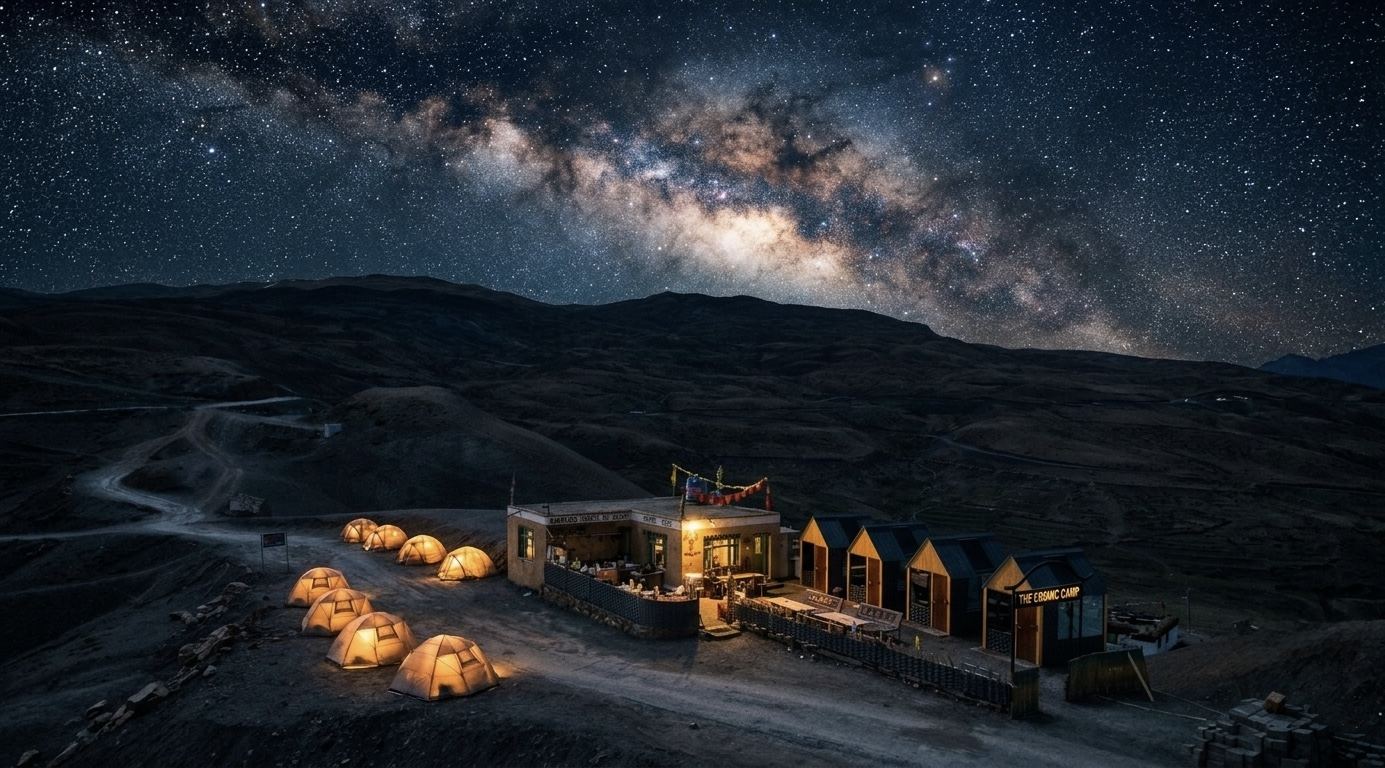
Our advice, having watched years of travellers pass through: don't day-trip everything from Kaza. The villages transform after the taxis leave — sleep at least one night high. Langza in particular rewards an overnight with sunset on the Buddha and a night sky Kaza's streetlights can't offer; that's the entire premise of The Cosmic Camp, fifteen kilometres and one big step above town.
When to come
Kaza works year-round — it is the one place in Spiti that never quite closes. Summer brings the crowds and the full café scene; October is golden and quiet; winter shrinks the town to its essentials and turns it into the staging post for snow leopard expeditions and frozen-valley travel (see Spiti in winter). For the full season-by-season picture, our best time to visit Spiti guide breaks down every month of the year.
Frequently asked questions
How many days should I spend in Kaza?
Plan at least one full night on arrival for acclimatisation — Kaza sits around 3,650–3,800 m. Two nights is better if you came up fast via Manali. After that, most travellers use Kaza as a supply-and-taxi base and sleep in the villages: Langza, Kibber, Komic or Tabo.
Are there ATMs in Kaza?
Yes — Kaza has a few bank branches and ATMs, but they run out of cash and lose connectivity often. Treat them as backup, not plan A: carry enough cash for your whole Spiti trip from Shimla, Reckong Peo or Manali. Above Kaza there are no ATMs at all.
Does Kaza have mobile network and internet?
BSNL and Jio work best in Kaza itself; Airtel is patchier. Coverage thins fast outside town and disappears in many villages. Download offline maps, tell people you'll be intermittently unreachable, and treat connectivity as a bonus rather than a given.
Where can I refuel in Kaza?
Kaza's fuel station — often celebrated as one of the highest retail fuel outlets in the world — is the only pump in the valley. Top up every time you pass. Riders and self-drivers heading toward Manali should leave Kaza with a full tank, since the next reliable pump is far down either road.
Is Kaza worth visiting in itself?
Modestly, yes. The Sakya monastery above town, the old quarter's lanes, the market and a genuinely good café scene make for a pleasant acclimatisation day. But Kaza's real job is to launch you at the valley — the magic is in the villages above it.
Stay with us in Langza
The Cosmic Camp is a pet-friendly stargazing camp with wooden cabins at 4,420 m in Langza village — nightly telescope sessions, fossil walks, an in-house café and a homemade ice-cream parlour, open all year round.
Book on WhatsApp