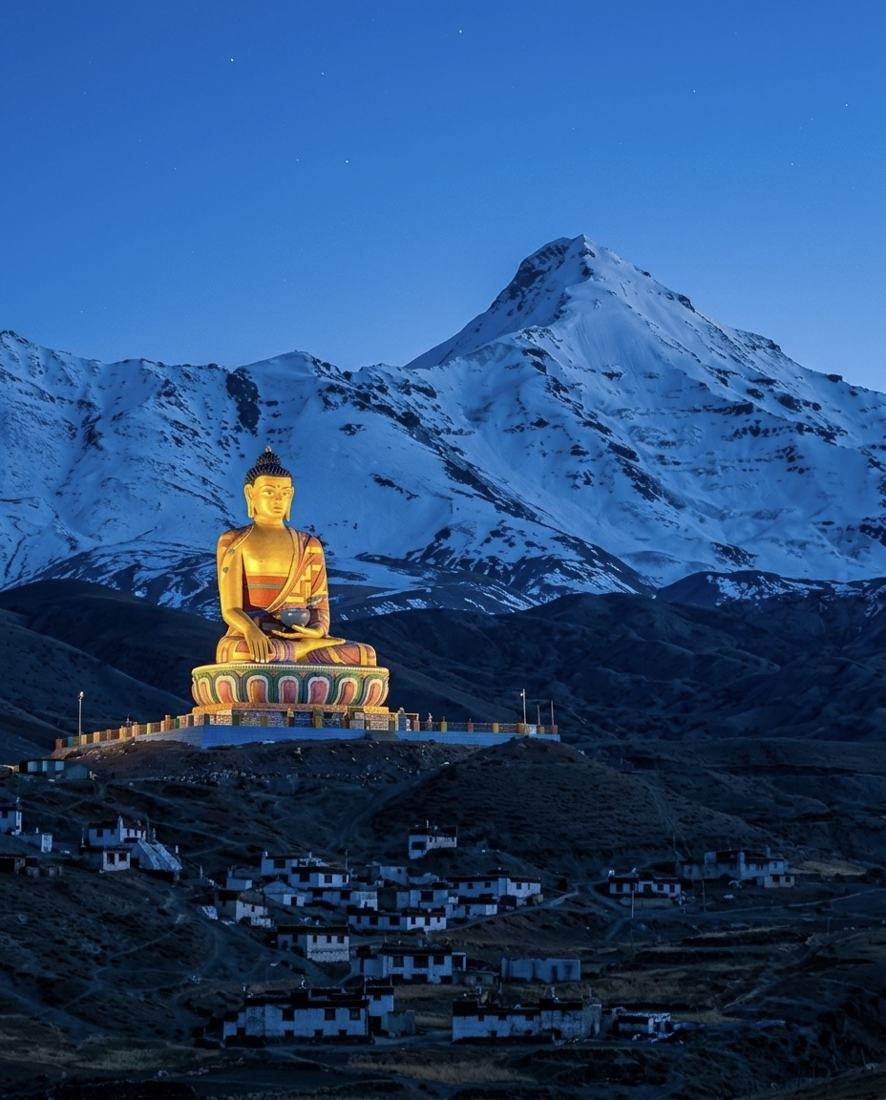
From the road, Langza announces itself twice. First you see the peak — Chau Chau Kang Nilda, a 6,300 m pyramid of snow and rock that locals hold sacred. Then, on a rise above the whitewashed houses, the Buddha: a giant seated Maitreya, painted gold, gazing out over the valley as if grading the view. Between the two sits one of the highest permanently inhabited villages on the planet.
Langza is tiny — a few dozen households, barley fields, yaks, a thousand-year-old temple — but it carries three superlatives that draw travellers up the 15 km road from Kaza: the fossils of an ancient ocean, a statue that has become the image of Spiti itself, and a night sky with essentially zero light pollution.
The golden Buddha
The seated Maitreya — the Buddha of the future — overlooks the village from a ridge at its upper edge, and has become Spiti's most photographed landmark. It is worth visiting twice: once in daylight for the view down the valley, and once at sunrise, when the first light hits the statue and the peaks behind it turn pink and gold. The statue is a short, gentle walk from the village; take it slowly at this altitude.
Photographers: the classic frame is from the fields south-west of the statue, with the Buddha in the foreground and Chau Chau Kang Nilda behind. In summer, green pea fields fill the foreground; in October, everything turns gold.
A village built on a seabed
Langza's second claim to fame is stranger than its first. The rock underfoot here was once the floor of the Tethys Sea — the ocean that separated India from Asia before the continents collided and the Himalaya rose. That collision lifted the old seabed more than four kilometres into the sky, fossils and all.
Walk the eroded slopes and gullies around the village with a local guide and you will find ammonites — spiral shells of marine creatures on the order of a hundred million years old — sitting loose in the mud where the mountain weathers them out. Locals call them chaudua. Holding a piece of ocean floor at 4,400 m, with snow peaks on the horizon, is the kind of perspective shift no museum can replicate. Fossil walks with a village guide are one of the signature experiences at The Cosmic Camp; we ask guests to leave fossils where they lie.
The Lang temple and village life
Langza's name is linked to the Lang — the village temple, held by local tradition to be around a thousand years old, which once served as an important shrine for the valley's scattered settlements. It is a working sacred site, not a monument: ask before entering, remove shoes, and skip photography inside unless invited.
The village itself divides into Langza Yongma (lower) and Langza Gongma (upper). Summer life revolves around the fields — barley and green peas, some of the highest agriculture anywhere — and livestock. Winters are long and hard; many families migrate down-valley or to Kaza during the deepest months, while others stay and keep the village alive under the snow. Visitors who come with patience and respect find Spitian hospitality here at its warmest: butter tea, a seat by the stove, and unhurried conversation.
- Altitude: ~4,420 m / 14,500 ft
- Population: roughly 130–150, in two clusters (upper and lower village)
- Distance from Kaza: 15 km / ~40 minutes
- Known for: Maitreya Buddha statue, marine fossils, Bortle 1 night skies, the ancient Lang temple
- Facilities: homestays, The Cosmic Camp's cabins and café; no ATM, no fuel — both are in Kaza
Things to do in and around Langza
- Sunrise at the Buddha — the single best half hour in the village.
- A guided fossil walk on the slopes above the village.
- Stargazing. Langza's sky is Bortle 1 — the darkest class there is. The Milky Way core in summer is life-list material; our full stargazing in Spiti guide explains when and how.
- The high-village circuit. Langza links with Hikkim (the world's highest post office — send yourself a postcard) and Komic (a spectacular clifftop monastery village) in an easy half-day loop. Details in our Langza–Hikkim–Komic circuit guide.
- Day hikes. Gentle walks toward the base of Chau Chau Kang Nilda, or village-to-village trails toward Komic, reward slow travellers. Go with a local guide and keep days short at this altitude.
- Wildlife watching. Blue sheep graze the slopes year-round; in winter this plateau is snow leopard country — see our snow leopard guide.
Practicalities
Getting here: Langza is a 15 km drive from Kaza; taxis run day trips, and self-drivers manage easily in dry months. The full route options from Manali, Shimla and beyond are covered in how to reach Langza. Money and network: carry cash from Kaza; mobile signal is patchy at best. Season: the road stays open most of the year, though heavy snowfall can close it for days in deep winter — Spiti in winter covers the cold-season picture.
Above all, come with time. Langza rewards the traveller who stays for sunset, for the night sky, and for the quiet morning after — which is exactly the rhythm a night at the camp is built around.
Frequently asked questions
Why is Langza called the Fossil Village?
Millions of years ago, the land that is now Spiti lay beneath the Tethys Sea. When India collided with Asia and the Himalaya rose, the old seabed was lifted skyward — so the slopes around Langza are full of marine fossils, especially spiral ammonites, which locals call chaudua. Guided fossil walks let you find and hold them where they lie.
Can I buy fossils in Langza?
Villagers do offer fossils and replicas to visitors, but removing genuine fossils depletes an irreplaceable natural record. We encourage guests to join a fossil walk, photograph what they find, and buy locally made replicas or other crafts instead — the experience is the treasure, and it keeps the hillsides intact for the next traveller.
How high is Langza and will I feel the altitude?
Langza sits at about 4,420 m (14,500 ft). Most visitors feel it — a faster heartbeat on stairs, mild breathlessness, sometimes a light headache. Sleep a night in Kaza first, walk slowly on day one and drink plenty of water, and the body usually adjusts within a day.
How many people live in Langza?
Langza is small — home to roughly 130–150 people across a few dozen households, split between the upper and lower village. Most families farm barley and green peas in summer and keep yaks and other livestock.
Is one day enough for Langza?
You can see the Buddha and walk the village in a couple of hours, but Langza's real character shows after the day-trippers leave — sunset light, a Bortle 1 night sky, and a slow village morning. If you can, stay a night; it changes the entire experience.
Stay with us in Langza
The Cosmic Camp is a pet-friendly stargazing camp with wooden cabins at 4,420 m in Langza village — nightly telescope sessions, fossil walks, an in-house café and a homemade ice-cream parlour, open all year round.
Book on WhatsApp