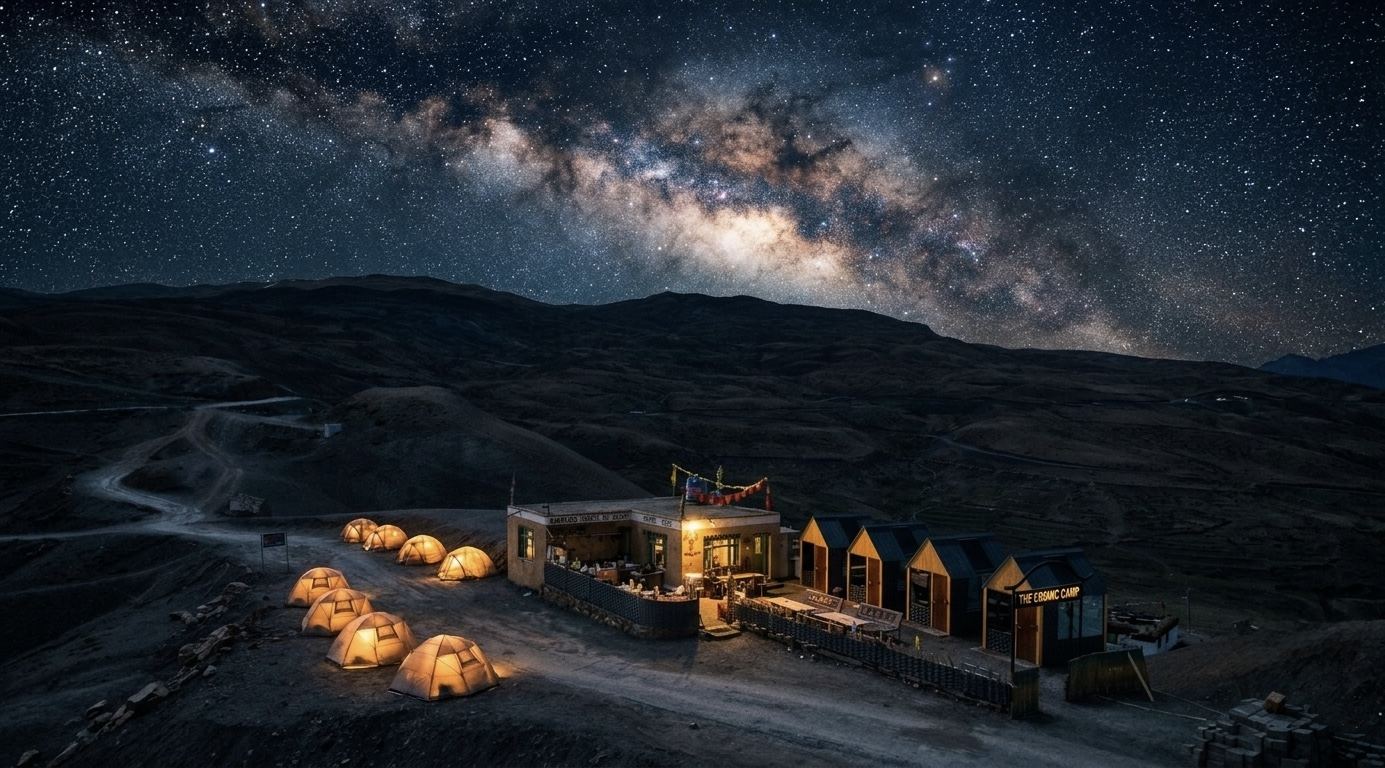
There is a reason Spiti keeps appearing on lists of the world's great drives. In one loop of roughly a thousand kilometres from Delhi and back, you climb from Himalayan foothills through the Sutlej gorges of Kinnaur, onto the cold desert plateau of Spiti, over a 4,500 m pass and down through Lahaul to Manali — with thousand-year-old monasteries, fossil villages and the darkest skies in India en route. It is spectacular, achievable and unforgiving of poor planning in about equal measure.
This guide covers the decisions that actually matter: direction, season, vehicle, fuel, the infamous water crossings, and what to carry.
The route, and which way to run it
The classic Spiti circuit links two approaches: the Shimla–Kinnaur road (NH-5 via Rampur, Reckong Peo, Nako and Tabo) and the Manali road (Atal Tunnel, Gramphu, Batal, Kunzum La, Losar). Full route detail lives in how to reach Langza; the overlander's question is direction.
Go clockwise: Shimla in, Manali out. Two reasons. First, acclimatisation — the Shimla road climbs gradually over two or three days, so you arrive at 4,000 m adjusted rather than ambushed. Second, sequencing — the roughest driving of the trip (Gramphu–Batal) comes at the end, when you and the vehicle are dialled in, and it's mostly descent. Counter-clockwise works, but it front-loads both the altitude and the hardest road.
Season
The full circuit runs only while Kunzum La is open — roughly June to October. Early June can still mean snow walls and heavy melt-water crossings; late October gambles on the first closing snowfall. Mid-June to September is the reliable window; September–early October adds golden light and empty roads. Outside that window, Spiti becomes an out-and-back on the Shimla road — see Spiti in winter before contemplating the cold-season version. The month-by-month guide has the full seasonal picture.
Vehicle and riding choices
- SUVs/crossovers: the comfortable default. Ground clearance matters more than drive wheels in season; a 4x4 buys margin in shoulder months and weather.
- Hatchbacks/sedans: plenty complete the Shimla route; the Gramphu–Batal stretch is where they scrape and suffer. Possible with care and patience, not pleasant.
- Motorcycles: the classic. Anything reliable from ~350 cc up with fresh tyres works; luggage low and waterproof, and dress for four seasons in one day.
- Whatever you drive: service it beforehand, and know that thin air saps engine power noticeably above 4,000 m — plan overtakes and climbs accordingly.
Fuel strategy
Fuel anxiety is the classic Spiti rookie stress, and it dissolves with one mental model: three anchors, always full.
- Kinnaur leg: top up at Rampur, and again around Reckong Peo — the last substantial pumps before Spiti.
- Kaza: the valley's only pump (celebrated as one of the world's highest retail outlets). Fill every time you pass, both directions.
- Manali leg: nothing dependable between Kaza and the Manali side — carry a small reserve can for this stretch, especially on a motorcycle.
The water crossings
The Gramphu–Batal–Losar stretch of the Manali road is the circuit's technical crux: an unpaved mountain road crossed by glacial melt streams. The rule that keeps it safe is about time of day. Glaciers melt with the sun, so crossings are lowest in the early morning and highest mid-to-late afternoon. Start this stretch at dawn, watch how local drivers pick their lines, cross steadily without stopping mid-stream, and if a crossing looks wrong — wait, or turn back. A night at Batal's dhabas beats a drowned engine every time.
What to carry
- Tyre essentials: a healthy spare (two tubes for bikes), puncture kit, portable compressor
- Tow rope, jump leads, basic tool roll, duct tape and zip ties
- Fuel reserve can (Manali leg), engine oil top-up
- Offline maps downloaded for the entire route — network vanishes for hours
- Cash for the whole trip (see the Kaza guide for why ATMs don't count as a plan)
- Water, snacks, warm layers and a headlamp in the cabin, not the boot
- Documents: licence, registration, insurance; foreign nationals need an Inner Line Permit for the Kinnaur stretch
Pacing: the mistake almost everyone makes
The classic error is treating Spiti as a transit stage — Shimla to Manali in four days, photographing the valley through a windscreen. The circuit's whole point lives off the main road: the Langza–Hikkim–Komic shelf, Key and Kibber and the Chicham bridge, Pin Valley, Dhankar's cliff-edge monastery. Build a minimum of two nights around Kaza into any itinerary — one in Kaza to acclimatise, one up high.
For overlanders, Langza makes a particularly satisfying high camp: you drive your own vehicle to 4,420 m, park beside a wooden cabin, and end a mountain-road day under a Bortle 1 sky with hot food and a real bed. The Cosmic Camp is pet friendly too — road dogs welcome — and if you want high-altitude driving beyond your own comfort zone, our local 4x4 off-road experiences let someone who drives this terrain daily take the wheel.
Frequently asked questions
Do I need a 4x4 for Spiti?
Not strictly, in season. The Shimla–Kaza road is doable in most well-maintained cars with reasonable clearance. The Gramphu–Batal stretch on the Manali side is where low cars suffer — rocks, ruts and water crossings favour high clearance, and a 4x4 adds a real margin in early season, late season and bad weather.
Which direction should I drive the Spiti circuit?
Clockwise — in via Shimla, out via Manali — is the smart default. You gain altitude gradually over two to three days (far better for acclimatisation), and you tackle the rough Gramphu–Batal stretch downhill-and-out with an acclimatised body and a shaken-down vehicle.
Where can I refuel on the Spiti circuit?
Plan around three anchors: the last big pumps of Kinnaur on the way up (top up at Rampur and again near Reckong Peo), Kaza's famous high-altitude pump in the middle, and nothing dependable on the Manali road until you're back near Manali. Fill at every anchor and carry a small reserve can for the Manali leg.
How bad are the water crossings on the Manali–Kaza road?
Variable. Snow-melt streams cross the Gramphu–Batal–Losar stretch and swell through the day as the sun melts the glaciers above — a rideable trickle at 8 a.m. can be a wheel-deep torrent by 3 p.m. Cross early, watch a local vehicle's line first, and never be proud about waiting or turning back.
Can I overland Spiti in winter?
Self-driving deep-winter Spiti is for genuinely experienced cold-weather drivers only: black ice, snow closures, −25 °C starts and no support. Most winter visitors are better served hiring local drivers who read the road daily. The Cosmic Camp runs guided 4x4 winter experiences for guests who want the drama with the judgment included.
Stay with us in Langza
The Cosmic Camp is a pet-friendly stargazing camp with wooden cabins at 4,420 m in Langza village — nightly telescope sessions, fossil walks, an in-house café and a homemade ice-cream parlour, open all year round.
Book on WhatsApp