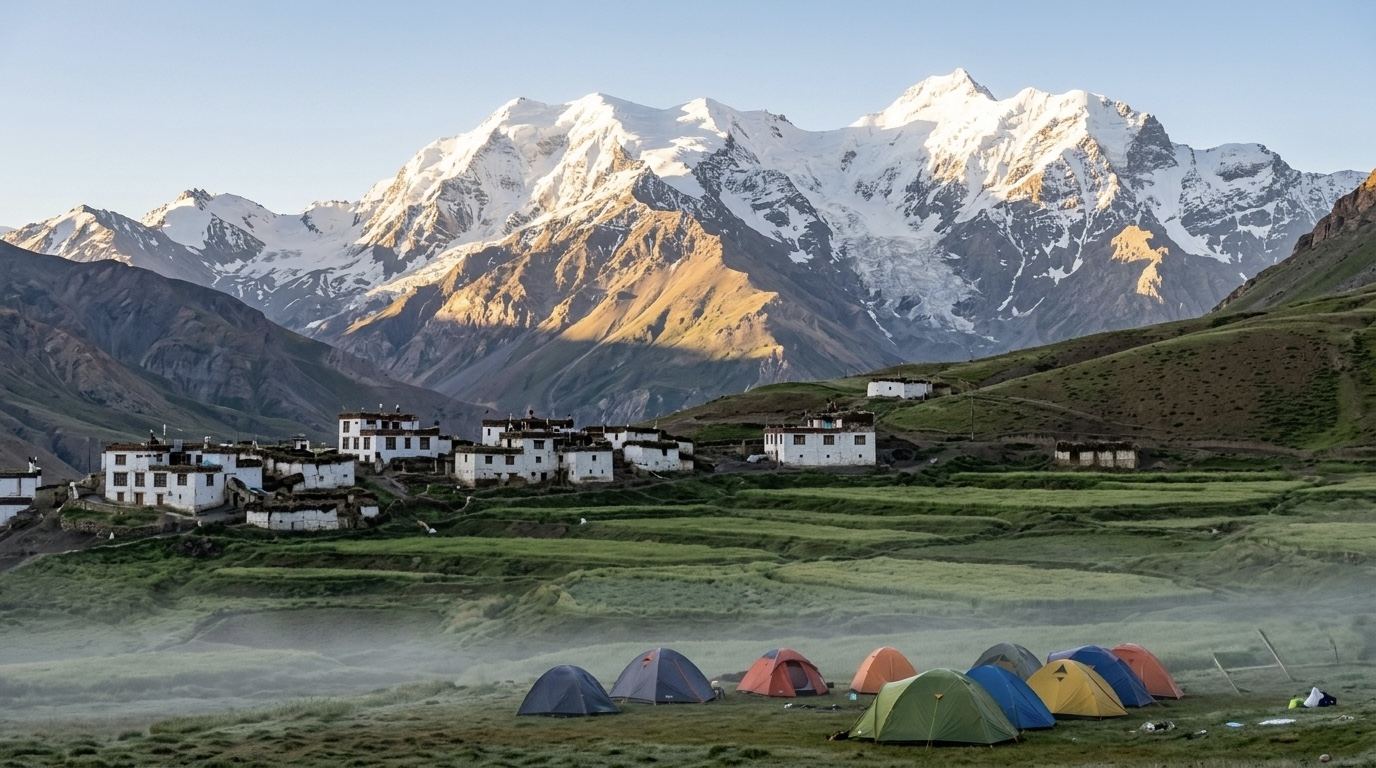
Ask five Spiti regulars for the best month and you'll get five confident, different answers. The photographer says October. The biker says June. The wildlife tracker says February. They're all right — because Spiti isn't one destination but four seasonal ones, sharing a set of mountains. The real question is which Spiti you want.
Below is the honest month-by-month picture: roads, temperatures, crowds, skies and wildlife. (One structural fact underpins everything: the Manali road over Kunzum La opens roughly June to October, while the Shimla–Kinnaur road runs nearly year-round. Full route detail in how to reach Langza.)
Month by month
| Months | Character | Access | Best for |
|---|---|---|---|
| Dec–Feb | Deep winter: −15 to −30 °C nights, snowbound valley, near-empty | Shimla road only, weather permitting | Snow leopards, Losar, solitude, winter skies |
| Mar–Apr | Late winter to thaw: cold, quiet, snow receding | Shimla road only | Late leopard season, snow landscapes with easier cold |
| May | Spring: villages wake, fields sown, passes still closed early-month | Shimla road; Manali opens late May some years | Quiet travel, early greenery, pre-crowd calm |
| Jun | Early summer: green fields, long days, everything open | Both roads (typically) | First-timers, bikers, Milky Way core season |
| Jul–Aug | Peak season: warmest, greenest, busiest | Both roads; monsoon delays possible on approaches | Full experience, family trips, pea-field landscapes |
| Sep | Early autumn: golden light, stable weather, thinning crowds | Both roads | Photography, trekking, relaxed travel |
| Oct | Autumn: gold-and-blue valley, cold nights, Manali road closing | Both early month; Shimla only by late Oct/Nov | Photographers, quiet-season travellers |
| Nov | Onset of winter: sharp cold, valley emptying | Shimla road | Solitude seekers, transition landscapes |
Summer (June to September): the classic Spiti
This is the valley most photographs show: green barley and pea fields against brown mountains, both roads open, every homestay and café running. June is arguably the sweet spot — fresh greenery, snow still crowning the peaks, and the Milky Way core rising through the evening for stargazing. July and August are warmest and busiest; Spiti itself stays dry (it's a rain-shadow desert), but the Manali and lower Kinnaur approaches can suffer monsoon landslides, so pad your schedule. September quietly outclasses them all for many travellers: stable roads, golden light and space to breathe.
Summer is also peak season for the high-village circuit and for overlanding trips — if you're planning the classic Shimla-in, Manali-out road journey, this is your window.
Autumn (October to November): the photographer's valley
October transforms Spiti. The fields turn gold, poplars and willows blaze along the river, the air scrubs itself glass-clear, and the summer crowds vanish almost overnight. Nights swing hard below freezing and the Manali road closes with the first heavy snow, but for landscape photography and quiet travel this may be the finest month of the year. November continues the retreat: colder, emptier, hauntingly beautiful — a taste of winter without its full commitment.
Winter (December to March): the wild card
Winter Spiti is a different expedition entirely: one open road, −20 °C nights, frozen taps, dry toilets — and rewards to match. This is snow leopard season, when the world's most elusive big cat descends to the slopes around Kibber, Chicham and the Langza plateau. It is festival season, with Losar celebrated in the villages. And it is the connoisseur's stargazing season: the year's longest, sharpest nights. It demands preparation and flexibility — read Spiti in winter honestly before committing — but nothing else in Indian travel resembles it.
Spring (April to May): the quiet thaw
Spring is Spiti's least-sold season, which is part of its appeal. The snow retreats uphill, villages sow their fields, and the valley runs at local rhythm with barely a tourist in sight. Access remains via Shimla until Kunzum La opens (late May in a good year, June more typically). Come now for solitude, shoulder-season prices and the strange beauty of a high desert waking up.
Two timing details people forget
The moon matters as much as the month. If night skies are any part of your plan, check the lunar calendar before fixing dates: within a few days of full moon, even Spiti's Bortle 1 sky loses the Milky Way to moonlight. Aim for the week around new moon in whichever month you choose.
Book the season, not just the dates. Peak-summer weekends fill Kaza and the popular villages, while winter operators are few and need notice to prepare cabins, fuel and food for guests. Shoulder seasons are the sweet spot for spontaneity; June–August and January–March both reward booking ahead.
Matching the month to your trip
- First Spiti trip: June or September.
- Motorcycle/self-drive loop: mid-June to early October.
- Milky Way photography: April to September, planned around new moon.
- Landscape photography: October, no contest.
- Snow leopards: January to March.
- Maximum solitude: November or April.
One constant across every season: the Langza plateau's Bortle 1 night sky, working every clear, moonless night of the year. The Cosmic Camp stays open through all of it — green Junes, golden Octobers and −25 °C Januaries alike — so whichever Spiti you choose, the stars are included. Start with what a stay looks like, and time the rest around the month that fits your trip.
Frequently asked questions
What is the overall best month to visit Spiti?
For most first-time visitors, June or September. June has both roads open, green fields, long days and prime Milky Way skies; September has golden light, stable roads, fewer crowds than peak summer and superb clarity. July–August work well too, with more traffic and occasional disruption on the Manali approach.
When is the Manali–Kaza road open?
Typically from around June, once snow is cleared from Kunzum La, until October or November when the first heavy snows close it. Exact dates vary by year — always check current status before planning. The Shimla–Kinnaur road remains the near-year-round alternative.
Does Spiti get monsoon rain?
Very little — Spiti is a rain-shadow cold desert, so July–August in the valley itself stays largely dry. The catch is the approach: the Manali side and lower Kinnaur can see monsoon landslides and delays in these months, so build buffer time into mid-summer trips.
When can I see snow leopards in Spiti?
Winter — roughly January to March — when snow pushes blue sheep and the leopards that follow them down to slopes near villages like Kibber, Chicham and Langza. Sightings are never guaranteed, but this window with local spotters gives by far the best odds.
Is Spiti worth visiting in winter?
For the right traveller, absolutely — empty landscapes, snow leopards, Losar festivities and the sharpest night skies of the year. But it is demanding: −20 °C nights, one open road and basic facilities. Read our dedicated winter guide before committing.
Stay with us in Langza
The Cosmic Camp is a pet-friendly stargazing camp with wooden cabins at 4,420 m in Langza village — nightly telescope sessions, fossil walks, an in-house café and a homemade ice-cream parlour, open all year round.
Book on WhatsApp