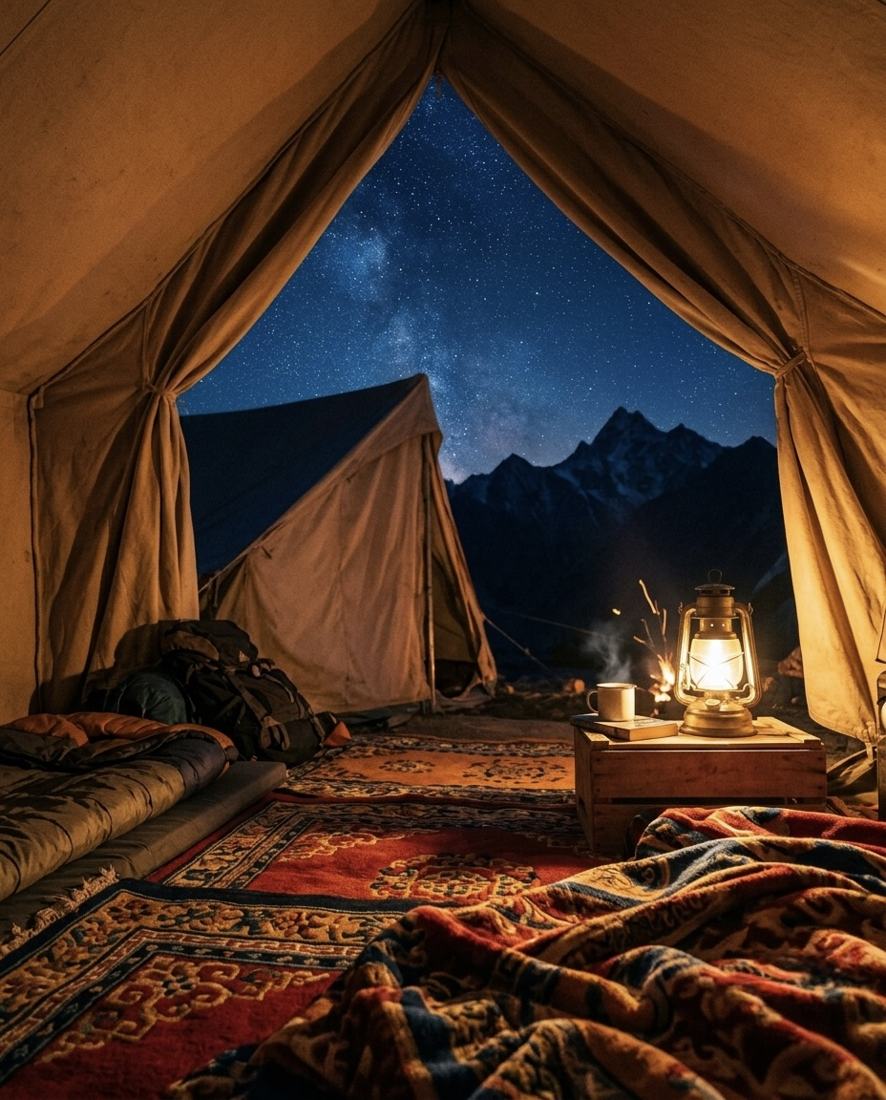
Most people see Langza for forty-five minutes. They drive up from Kaza, photograph the golden Buddha, buy a fossil, and drive back down. Camping here flips that experience: the day-trippers leave by late afternoon, the light turns amber on the Chau Chau Kang Nilda peak behind the village, and by nine at night you are standing under one of the darkest measurable skies on the planet.
This guide covers the practical side of that experience — where to sleep, how to handle the altitude, what to pack, and what a night in the Fossil Village actually feels like across the seasons.
Why camp in Langza rather than stay in Kaza?
Kaza is the sensible base for Spiti — it has fuel, ATMs, mechanics and mobile network. But it is also a town, with streetlights and traffic. Langza, 15 km and about forty minutes up a switchback road, is a farming village of a few dozen households at 4,420 m with essentially zero light pollution. The difference at night is not subtle: from Langza the Milky Way core is bright enough to cast a faint glow, and on a moonless night you can see zodiacal light — something most people have never seen in their lives.
The other reason is time. Staying overnight means you catch the two moments day-trippers always miss: sunset on the Buddha statue and the high peaks, and sunrise, when the village wakes up, smoke rises from kitchen fires and the fields glow gold.
Cabins, homestays or tents?
You have three realistic options in Langza, and they are not equal.
- Wooden cabins. This is what we build and run at The Cosmic Camp — insulated cabins with proper beds, bedding rated for high-altitude nights, and a nightly telescope session included. The Stargazer Cabin sleeps two adults at ₹3,500 per person per night. Cabins are the only option we recommend from late autumn to spring.
- Village homestays. Several families in Langza host guests in traditional mud-and-timber homes. Expect simple rooms, shared washrooms, home-cooked food and genuine hospitality. A wonderful cultural experience, especially in summer.
- Your own tent. Possible in July and August if you are experienced and self-sufficient, but nights drop near freezing even in peak summer, and the ground is farmland or pasture — always ask before pitching. In any other season, don't.
The altitude, honestly
Langza is higher than Everest Base Camp's first acclimatisation stops, and coming up too fast is the single most common way visitors ruin their trip. The rules are simple and worth following:
- Sleep a night lower first. Kaza (~3,800 m) or Tabo (~3,280 m) are ideal staging points. If you have come via the Shimla road, you have been gaining height gradually for days, which helps enormously. The Manali route via Kunzum La gains height much faster — be extra careful.
- Hydrate more than feels natural. Cold, dry air at altitude dehydrates you quickly. Three to four litres a day is a good target.
- Skip alcohol for the first day or two, and eat light, carbohydrate-heavy meals.
- Know the symptoms. A mild headache on arrival is common and usually settles with rest and water. A worsening headache, vomiting, breathlessness at rest or confusion means descend to Kaza — it is only forty minutes away, which is part of what makes Langza a forgiving place to acclimatise.
- Altitude: 4,420 m / 14,500 ft
- Distance from Kaza: 15 km, roughly 40 minutes by road
- Sky quality: Bortle 1 — the darkest class on the scale
- Open season: year-round; winter access via the Shimla–Kinnaur road
- Mobile network: patchy — expect Jio/BSNL signal in spots, and plan to be mostly offline
What to pack for a Langza camp stay
Layers beat bulk. Even in July, you will want a warm jacket the moment the sun goes down.
- A proper insulated jacket year-round, plus thermals from September to May
- Woollen cap, gloves and warm socks — you will be standing still at a telescope at night
- Sunscreen, sunglasses and a lip balm; UV at 4,400 m is fierce
- A headlamp with a red-light mode — white torches wreck night vision for everyone at a stargazing camp
- Personal medication, plus paracetamol for altitude headaches (consult your doctor about Diamox before the trip)
- Power bank — electricity in the village is limited, though the camp has solar charging
- Cash. There are no ATMs in Langza and cards are useless; the nearest reliable cash is in Kaza
A night at the camp, hour by hour
Arrive by mid-afternoon so your body gets easy hours at altitude before dark. Walk gently through the village, up to the Buddha statue, and let the day-trip crowds thin out. Dinner at the café is early — thukpa or dal-rice, something warm — because the main event starts after dark.
The nightly telescope session begins once the sky is properly black. Our team walks you through what is overhead that season, from the Milky Way core in summer to Orion's winter nebulae, with red-light etiquette and help for anyone trying astrophotography for the first time. No experience is needed; you just look up. Then heavy bedding, a warm cabin, and — if you can manage it — an alarm for sunrise.
When to come
Every season gives you a different Langza. May to September is green-field, easy-access season with the Milky Way core overhead — the classic choice. October turns the valley gold and the air glass-clear. Winter, from December to March, is the wild card: brutally cold, staggeringly beautiful, snow leopard territory, and the camp remains open for those who want Spiti at its most raw. For a month-by-month breakdown, read our guide to the best time to visit Spiti, and if the cold season tempts you, Spiti in winter covers it honestly.
Getting here is straightforward once you know the routes — the full picture, including buses, taxis and self-drive notes, is in how to reach Langza. And if the night sky is your main reason for coming, start with our guide to stargazing in Spiti.
Frequently asked questions
Is camping in Langza safe?
Yes, provided you respect the altitude. Langza sits at 4,420 m, so spend a night in Kaza (around 3,800 m) first, drink plenty of water, avoid alcohol on day one, and go easy for the first 24 hours. The village itself is small, welcoming and very safe for travellers, including solo travellers and families.
Can I camp in Langza in winter?
Yes. The Cosmic Camp stays open through winter, when nights regularly fall to −20 °C or below. Insulated cabins, heavy bedding and hot food make it workable — a tent, by contrast, is genuinely dangerous at these temperatures unless you are an experienced winter mountaineer. Winter access is via the Shimla–Kinnaur road only.
Do I need to carry my own tent to Langza?
No. Staying in a cabin or homestay is safer and far warmer than a personal tent at this altitude, and it puts money into the village economy. If you do pitch your own tent in summer, ask permission — most flat land around Langza is farmland or grazing pasture that belongs to someone.
Is Langza pet friendly?
The Cosmic Camp is fully pet friendly and pets stay free. Keep dogs leashed around livestock — the village grazes yaks, cows, donkeys and sheep — and give them time to acclimatise too; altitude affects animals just as it affects people.
What food and water are available while camping in Langza?
The camp has an in-house café serving Spitian and Indian food — momos, thukpa, dal-rice, sea-buckthorn chai — plus a homemade ice-cream parlour. Carry a refillable bottle; boiled and filtered water is available, and buying fewer plastic bottles matters in a valley with no real waste processing.
Stay with us in Langza
The Cosmic Camp is a pet-friendly stargazing camp with wooden cabins at 4,420 m in Langza village — nightly telescope sessions, fossil walks, an in-house café and a homemade ice-cream parlour, open all year round.
Book on WhatsApp