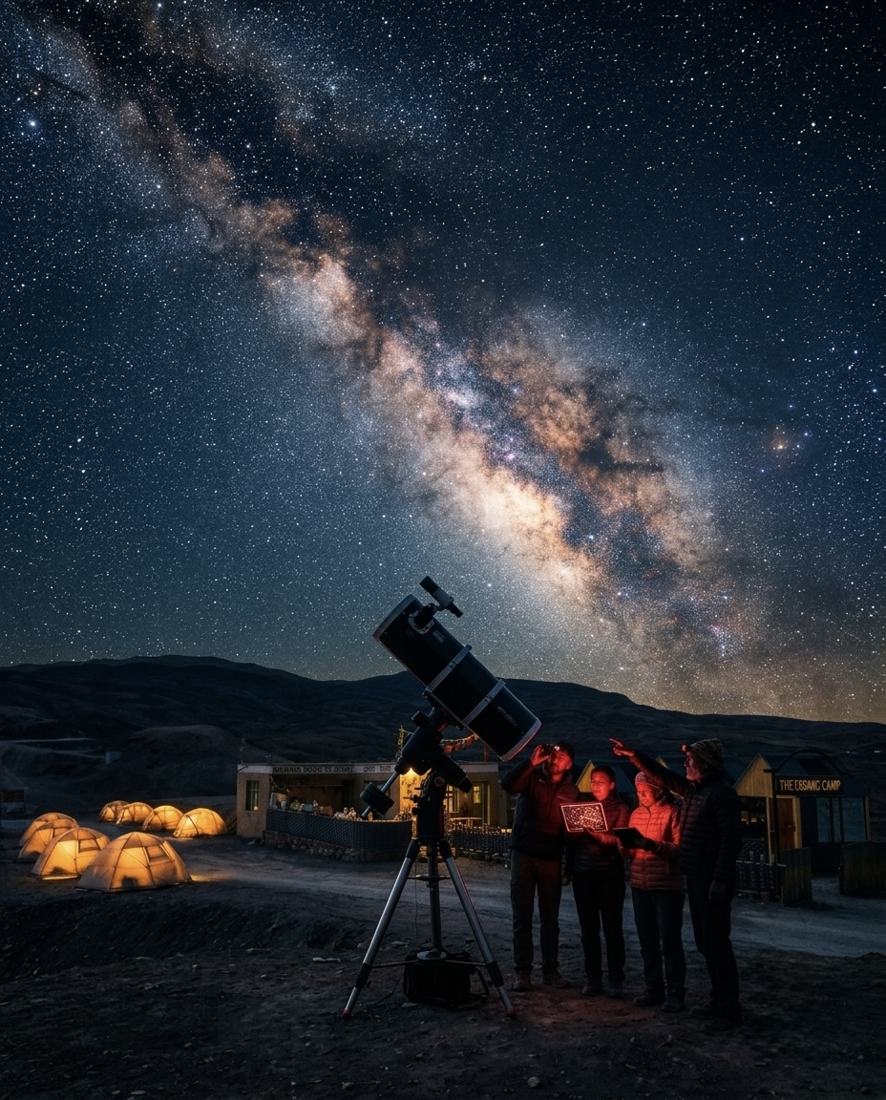
There are places you go to see mountains, and places you go to see what the sky looked like before electricity. Spiti is the rare valley that offers both. At 4,000+ metres, above most of the atmosphere's water vapour, in a cold desert with a handful of small villages and no cities for a hundred kilometres, the night sky here is not a backdrop — it is the destination.
This guide explains why Spiti's sky is exceptional, when to time your trip, where to stand, and how to get the most out of a night under it, whether you carry a camera or just your eyes.
Why Spiti's sky is genuinely special
Three things have to line up for a world-class night sky, and Spiti has all of them.
- Darkness. The Bortle scale grades light pollution from 9 (inner city) to 1 (pristine). Villages like Langza measure Bortle 1 — a class most people on Earth have never experienced. There is simply nothing here to make light: no towns of any size, no highways, no industry.
- Altitude. At 4,420 m, Langza sits above a significant slice of the atmosphere — and crucially above most of its water vapour, which is what blurs and dims starlight at lower elevations.
- Dry air. Spiti is a rain-shadow cold desert. Humidity is routinely very low, which means exceptional transparency: faint objects that are theoretical elsewhere are obvious here.
The practical result: on a moonless night you can see the Milky Way's central bulge casting shadows-edge glow, the Andromeda galaxy naked-eye, meteors every few minutes, and — if you know to look for it — the zodiacal light, a pyramid of glow along the ecliptic caused by sunlight on interplanetary dust.
What you'll see, season by season
April to September: Milky Way core season
The galactic centre — the dense, dramatic part of the Milky Way in Sagittarius and Scorpius — rises in the pre-dawn hours in early spring and dominates the evening sky by June and July. This is the season for the classic arching-Milky-Way photograph. Summer also brings the Perseid meteor shower in mid-August, which under a Bortle 1 sky is a genuine spectacle rather than a patience exercise.
October to November: transition and clarity
The core sinks toward the horizon after sunset, but October's post-monsoon air (Spiti gets little monsoon, but the region's haze clears) is often the year's most transparent. Andromeda and the Pleiades ride high; nights get long.
December to March: the winter sky
The coldest nights are the sharpest. Orion, the Orion Nebula, Sirius blazing, the Winter Hexagon, Geminid meteors in December — all over a snowbound valley. Sessions are short (the cold is serious) but unforgettable. If that appeals, our Spiti in winter guide covers the logistics.
Where to stargaze in Spiti
Almost anywhere away from Kaza's modest lights works, but altitude and open horizons separate the good spots from the great ones. Langza is the standout: high, open to the south (where the Milky Way core sits), and effectively free of artificial light. Komic and Hikkim, on the same high shelf, are comparable — the whole Langza–Hikkim–Komic circuit is dark-sky country. Kibber and Demul also offer superb skies.
The deciding factor is usually not the spot but the logistics: standing outside at night at 4,400 m means you want warmth, hot food and a bed within a hundred metres. That is the entire reason The Cosmic Camp exists in Langza rather than as a viewpoint you drive to — the nightly telescope session ends with a warm cabin, not a cold drive back down.
Planning around the moon
The single biggest mistake stargazing trips make is ignoring the lunar calendar. In a sky this dark, the moon is a floodlight: within a few days of full moon, the Milky Way all but disappears. Aim for the window from a few days before new moon to a few days after. (A bright moon isn't worthless — moonlit snow peaks are their own show — but if the galaxy is your goal, plan dark.)
Astrophotography basics that work here
- Phone: any recent phone with a night/astro mode, propped on a rock or mini tripod, will capture the Milky Way here. Use a 3-second timer to avoid shake.
- Camera: wide lens (14–24 mm), aperture wide open (f/1.8–f/2.8), ISO 1600–3200, 15–20 second exposures. Focus manually on a bright star using live view.
- Batteries die fast in the cold — keep spares in an inside pocket.
- Red light only. One white torch ruins dark adaptation for everyone around you for half an hour. Our sessions run on red-light etiquette, and your fellow guests will thank you.
Make a trip of it
The sky is reason enough to come, but it pairs naturally with everything else on the Langza plateau: fossil walks by day, the Hikkim post office and Komic monastery circuit, and mornings at the golden Buddha. Time your dates with our month-by-month Spiti guide, sort logistics with how to reach Langza — and then let the sky do what it has done here every clear night for four billion years.
Frequently asked questions
What is the best month for stargazing in Spiti?
For the Milky Way core, aim for April to September, with June being especially good — long galactic-centre visibility and mostly stable weather. Winter (November to March) trades the core for brilliant, crisp skies over Orion and the winter constellations, with the longest nights of the year.
Can you see the Milky Way with the naked eye in Spiti?
Yes, unmistakably. Under Langza's Bortle 1 sky on a moonless night, the Milky Way core is bright enough to show structure — dust lanes, the bulge — without any equipment. Give your eyes 20–30 minutes to dark-adapt and avoid white light.
Do I need a telescope for stargazing in Spiti?
No. The naked-eye sky is the main event, and binoculars (8x42 or 10x50) show star clusters and the Andromeda galaxy beautifully. The Cosmic Camp runs a nightly telescope session for guests, so you get magnified views of planets, nebulae and clusters without carrying anything.
How does the moon affect stargazing in Spiti?
Enormously. A full moon washes out the Milky Way even in a Bortle 1 sky. Plan your visit within roughly five days either side of a new moon for the darkest conditions — check a moon-phase calendar before booking dates.
Is Spiti good for astrophotography beginners?
It is one of the most forgiving places to learn. The sky is so bright with stars that even a phone in night mode on a small tripod captures the Milky Way. With a basic mirrorless or DSLR, a wide lens at f/2.8, 15–20 second exposures and ISO 3200 will get you striking results on your first night.
Stay with us in Langza
The Cosmic Camp is a pet-friendly stargazing camp with wooden cabins at 4,420 m in Langza village — nightly telescope sessions, fossil walks, an in-house café and a homemade ice-cream parlour, open all year round.
Book on WhatsApp